Do you have customers, or students in your classroom and school?
Someone on #edchat on twitter posted a quip that was hard to figure out about auto repair shops and how we didn’t get to know our “customers” in education. Twitter is like a cocktail party, and I definitely walked into that conversation mid-way, so he might have been making an excellent point, but I really do not like using the word “customer” to describe the families that we serve as public school educators. I don’t like it because it makes a number of assumptions about customers, and the service they receive in private businesses.
Public schools take all comers. The number of students going to “alternative” placements is pretty darn small, and even then, their education is still the financial and legal responsibility of the school district where they live. Private business do not have to serve anyone who comes through their door.
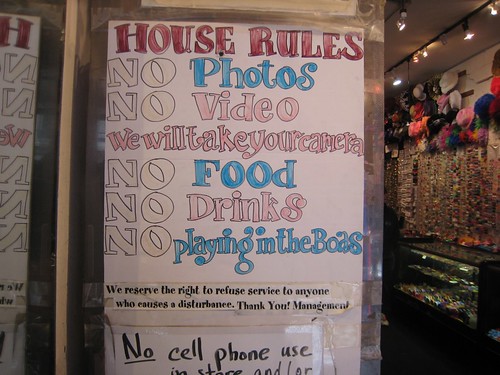
Look at the sign above. It looks similar to a list of “rules” you might see in some classrooms (we can quibble about the wording, etc.), but here is what’s different about a classroom, and a business…that line in the middle about reserve the right to refuse service to anyone who causes a disturbance. When a kid in my class causes a disturbance, I may be able to remove him, but you can bet, I’ll have to provide him with more services as the weeks go on. Refusing to provide service will not be an option.
If I were a “business” I could refuse to keep that child as a “customer”, and I’d have no responsibility to find him an alternative to my services. Business have a myriad of methods to avoid having certain customers, to get rid of customers they no longer desire, and to limit and segregate customers to maximize profits and minimize their risk. I don’t get to refuse customers. Playing favorites with my students, the way that businesses do with their customers, is not considered a “good” practice in my profession. I do not have customers because I have more respect for my students and families than to treat them that way.
Photo credit: House Rules by Lynn Friedman, on Flickr