Pandemic Teaching – What’s up?
November27
Responding to the call from Pocketful of Primary to answer questions about how teaching during the pandemic is going.
Responding to the call from Pocketful of Primary to answer questions about how teaching during the pandemic is going.

I’m still tired. This week, it’s mostly due to poor planning on my part, and things in my family life. Class, that’s settling into a routine. I’m making adjustments as I get feedback from my parents. Mostly it’s about giving kids “breaks” but also transition signals and check-ins to get them or keep them on track. I’m running classes about 30 minutes of direct instruction, then 30+ minutes for them to work independently finishing up work based on what I taught. The direct instruction includes Nearpods or discussions (small group or whole class).
A notable recent moment in the classroom was during the novel I’ve been reading to students, Rick Riordan’s The Red Pyramid which is part of his Kane Chronicles series based on Egyptian Mythology. I picked the book out because I wanted to find a fun book to start out the school year, and I wanted to have a non-white character, since most of those types of books used in elementary, and most of the novels that have traditionally been used for fourth grade have white characters. I had read the novel to my son when he was younger (but older than 9). The story starts with an explosion at the British Museum, where the Kane family was visiting after hours. Dad is African American Egyptologist. The kids are mixed, their mom was a white British anthropologist, who sadly has died under mysterious circumstances. The police start to question the kids, and the boy (who looks like dad) is getting a harder time than the girl (who resembles her late mom). The characters notice the difference, but even before that, one of my students raised their hand to bring it up.
The student believed that this was because they were Muslim. I had to explain to them that although that would be a problem, it was because of their race, as they are not Muslim and as we’ll find out later, they’re actually practicing a religion that pre-dates Islam, although Islam is the dominant religion in present day Egypt. It was a good intro to world religions, and discussion of racial profiling. I wasn’t sure how well this novel would work, because it does have a white author, but he actually does an okay job exploring issues of colorism that happen in mixed families. Since a lot of the African American families in our school are mixed, it’s a good topic to explore.
Week Two is the first, full five day week of teaching. It went good. The kids are getting from Zoom to Nearpod quicker, but it’s still taking time. Today, I’m going to talk about the SEL things I’m doing. I will admit that I have a MUCH easier time “establishing” a class community because I’ve looped with about 2/3rds of my class from last year. I think there are still some things in here that could help.
Answers to these questions are more important at this point, and how they are feeling is critical too (I have a daily check in for that).
I like distance teaching. I’m going to admit that up front. You may not feel the same, and that’s fine. I’m hoping however things are going, you’ll find something of use in my reports.
Image credit: DIGITAL NUMBER 2
I used to do a weekly review of my week in the classroom and before that, the computer lab. I thought it might be a good time to revive that practice.
First, some background. I am teaching a fourth grade classroom that is largely comprised of students I had last year in third grade. This is my first time teaching fourth grade in a long time, but it’s after two years teaching third grade, and a lotta years teaching sixth and fifth grade. Doing a “loop” up with my kiddos and their families is a great opportunity in a situation like distance learning, so I consider myself fortunate, and I hope that my families appreciate having someone that knows them, and that they know.
This week started with a lot of chaos and confusion around scheduling that I will not belabor, but since the start time was the same and I had already established solid contact with my families, so I had 90% attendance, and have run about the same since then. I do have some concerns (which I won’t go into, privacy) but I have a supportive admin who is aware of them, etc.
Here are some tips based on this week (and prior experience last year):
I hope this will prove useful to others. If you have a tip, leave a comment below.
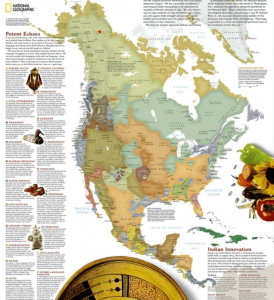
I like to use physical two-dimensional maps with students. I think they can be very useful to show the movements and changes in a place like the United States that has changed quite a bit since Europeans began coming en masse since the 1500s.
I recently used his map from National Geographic in my third grade class. There are a number of maps overlaying Native American groups (by tribe, language, culture, etc.) that have started to appear online in the last few years. My students’ textbooks have a California map similar to this one.
The problem with showing a map with political boundaries (the present day California) rather than the whole continent is that it centers the current day boundaries, which are often arbitrary. What I talked about with my students was how these tribes and groups did not stop at the present-day border. Next week they will be studying about the Kumeyaay, a tribe with members on both sides of the California and Mexico border. We also discussed the Yurok, who have a very different lifestyle, etc. and have a lot more in common with tribes going up along the coast now in Oregon. I want them to think out side these borders, and understand they don’t have much to do with how these groups lived for millennia before Europeans invaded.
Image source: North American Indian Cultures Wall Map from National Geographic



Recent Comments